

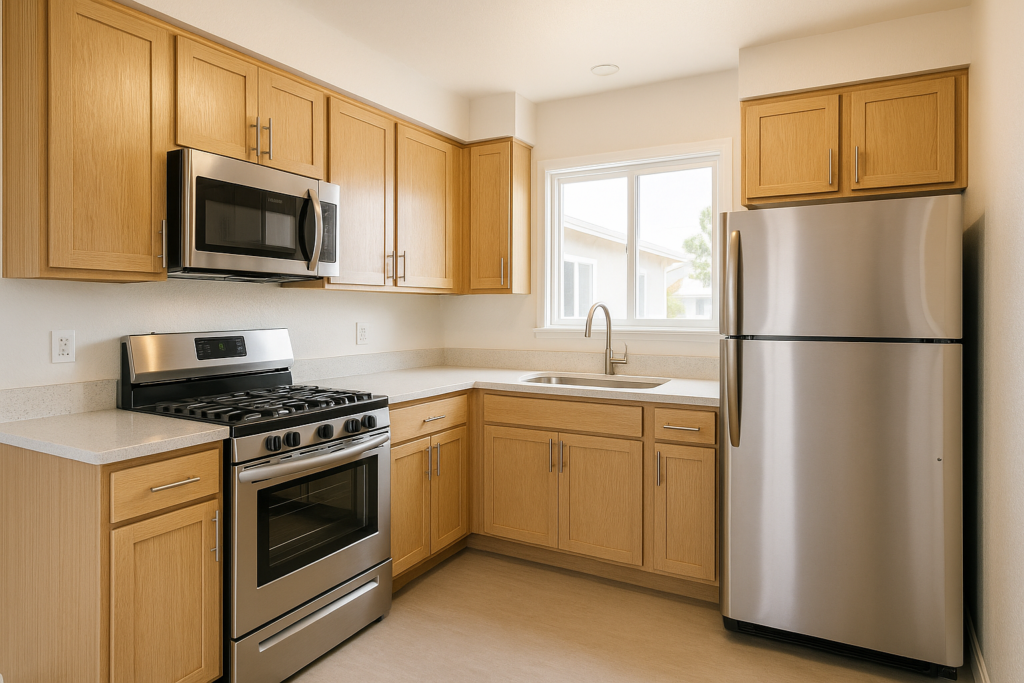
As of January 1, 2026, a San Diego landlord who fails to provide a working stove or refrigerator is not just risking a bad review, they may be violating California law. A new statute, AB 628, added kitchen appliances to the list of things a landlord must supply and maintain in most residential rentals, and tightened the clock on fixing recalled ones. Combined with California’s long-standing habitability requirements, 2026 raises the bar for what “livable” legally means. This is the 2026 habitability checklist every San Diego landlord needs to meet, before a tenant complaint becomes a legal problem.
What is the implied warranty of habitability?
Every residential lease in California carries an implied warranty of habitability: a legal guarantee that the rental will be fit to live in, whether or not the lease says so. Landlords are responsible for keeping the unit in a condition that meets basic health and safety standards for the entire tenancy. This includes core essentials: working plumbing and hot and cold running water, safe electrical, adequate heating, weatherproofing and a sound structure, working locks and safety devices, and freedom from pest infestations and hazards.
Habitability is not optional and cannot be waived away in the lease. It is the baseline every San Diego rental must clear, and 2026’s new rules expand what sits inside that baseline.
What did AB 628 change for 2026?
AB 628, effective January 1, 2026, added a specific and practical obligation: in most residential rentals, landlords must provide and maintain a working stove and refrigerator. Kitchen appliances that many owners treated as optional or “tenant’s problem” are now part of the landlord’s habitability responsibility.
The law also put a clock on defective appliances: a recalled appliance must be repaired or replaced within 30 days of the landlord receiving notice. That is a hard deadline, not a suggestion, and it means owners need a process for responding to appliance problems, not an ad-hoc “I’ll get to it.”
For San Diego landlords, the practical takeaway is simple: if your unit does not have a functioning stove and refrigerator, or you are slow to deal with a recalled appliance, you are now on the wrong side of a 2026 law.
What are the other 2026 rules landlords should know?
AB 628 did not arrive alone. Several California laws took effect January 1, 2026 that reshape a landlord’s obligations, and a compliant owner should have all of them on the checklist:
- Post-disaster protections (SB 610): during a mandatory evacuation, landlords must halt rent and other fees, remove debris after a natural disaster, and return prepaid rent and deposits if a unit becomes uninhabitable. In a wildfire-exposed region, this is a real operational rule, not a hypothetical.
- Social Security payment protection (AB 246): if a tenant pays rent with Social Security income and that payment is delayed for reasons beyond their control, they cannot be evicted for nonpayment during the disruption, for up to 180 days.
- Security-deposit handling (AB 414): if a tenant paid their deposit electronically, refunds generally must be returned by the same method, and itemized deduction statements may be delivered by email with mutual written consent.
- Internet opt-out (AB 1414): tenants must be given the opportunity to opt out of paying for certain third-party internet service bundled with the tenancy.
Each of these narrows what a landlord can charge for, evict over, or ignore, and each belongs on a 2026 compliance checklist alongside the appliance rules.
What is the 2026 habitability checklist?
Bring your San Diego rental into 2026 compliance by confirming each of the following:
- 1. Working stove and refrigerator provided and maintained (AB 628).
- 2. A process to address recalled appliances within the 30-day window.
- 3. Plumbing and water: functioning plumbing with hot and cold running water and proper drainage.
- 4. Heating: adequate, working heat.
- 5. Electrical: safe wiring, outlets, and panel with no obvious hazards.
- 6. Structure and weatherproofing: sound roof, walls, windows, and doors that keep the weather out.
- 7. Safety devices: working smoke and carbon-monoxide detectors and functioning locks.
- 8. Pest-free and hazard-free: no infestations, mold, or unaddressed safety hazards.
- 9. Exterior elements (multifamily): balconies, decks, and stairways inspected and maintained per California’s inspection laws.
- 10. A documented repair-response process so habitability requests are handled promptly and on the record.
The last item is the connective tissue: habitability is not just about condition on day one, it is about how quickly and consistently you respond when something breaks during the tenancy.
Does habitability apply to older buildings and every rental?
Yes, and this trips up owners of San Diego’s abundant older housing stock. The implied warranty of habitability applies to essentially every residential tenancy regardless of the building’s age, and the 2026 appliance rules apply to most residential rentals, not just new ones. An older Craftsman in North Park or a mid-century fourplex in a beach community owes its tenants the same working stove, refrigerator, heat, water, and safe structure as a brand-new build.
Age is not an excuse; it is a reason for extra diligence. Older systems fail more often, so the owner of a vintage San Diego property has to be *more* proactive about inspections and repairs to stay habitable, not less. The law measures the unit against a livability standard, not against how old it is, so “it’s an old building” is never a defense to a habitability claim.
What happens if you ignore a habitability problem?
Failing to maintain a habitable rental exposes a San Diego landlord to serious consequences. Depending on the situation and severity, a tenant may have the right to pursue repair-and-deduct remedies, withhold rent in certain circumstances, break the lease, or sue for damages, and a habitability failure is a strong shield against an eviction if the landlord tries to remove a tenant who complained. Retaliating against a tenant for asserting habitability rights is separately unlawful.
There is also the compounding cost: a small maintenance issue ignored becomes a habitability violation, which becomes a legal dispute, which becomes far more expensive than the original repair. In 2026, with appliances explicitly on the list and tight timelines on recalls, the window for “I’ll deal with it later” has narrowed considerably.
How should you handle a habitability complaint?
Speed and documentation are everything. When a tenant reports a habitability issue:
- Acknowledge it promptly and in writing, so there is a record you responded.
- Assess and repair quickly, prioritizing anything affecting health, safety, or a core essential like heat, water, or now a working stove or fridge.
- Respect entry rules: give proper written notice before entering to inspect or repair.
- Meet the deadlines the law imposes, including the 30-day recalled-appliance window.
- Document everything: the complaint, your response, the repair, and the dates.
A landlord who responds fast and keeps records rarely ends up in a habitability dispute. A landlord who lets requests sit is the one who does.
Why does professional management keep you compliant?
The 2026 rules turned habitability from a broad principle into a specific, deadline-driven checklist, appliances, recalls in 30 days, disaster rules, deposit handling, and more, layered on top of California’s existing standards and San Diego’s local protections. Keeping all of it straight, and responding to every tenant request within the required timelines, is exactly where owners slip.
A professional manager operationalizes compliance: a documented repair-response process, prompt handling of habitability requests, a vendor network that fixes problems inside the legal windows, and records that prove you met your obligations. Just as importantly, a manager stays current as the rules change each year, so a new January 1 statute does not quietly turn you into a violator. For an owner who wants to stay on the right side of California’s ever-expanding tenant protections without tracking every new law themselves, that is the core of what management provides.
Frequently asked questions about 2026 habitability rules
Do I have to provide a stove and refrigerator in my California rental?
As of January 1, 2026, AB 628 requires landlords to provide and maintain a working stove and refrigerator in most residential rentals, and to repair or replace a recalled appliance within 30 days of notice.
What is the implied warranty of habitability?
It is a legal guarantee in every California residential lease that the rental will be fit to live in, with working plumbing, water, heat, electrical, weatherproofing, safety devices, and freedom from hazards, for the entire tenancy. It cannot be waived in the lease.
How fast must I fix a recalled appliance in 2026?
Within 30 days of receiving notice, under AB 628. This is a firm deadline, so owners need a process to respond to appliance problems promptly.
What can a tenant do if I ignore a habitability problem?
Depending on the situation, a tenant may pursue repair-and-deduct, withhold rent in certain circumstances, break the lease, or sue for damages, and the habitability failure can block an eviction and support a retaliation claim if you act against a complaining tenant.
Are there other new 2026 laws I should know about?
Yes, including post-disaster rent and fee protections (SB 610), Social Security nonpayment protection (AB 246), electronic security-deposit refund rules (AB 414), and an internet-service opt-out (AB 1414). All took effect January 1, 2026.
Meet the 2026 bar before a tenant does
Habitability in San Diego is no longer just “keep the place livable”, as of 2026 it is a specific checklist with appliances on it and deadlines attached. A working stove and refrigerator, recalled appliances handled within 30 days, the core essentials maintained, and a documented process for responding fast to complaints: clear that bar and you are protected. Ignore it and you hand tenants a rent-withholding remedy, an eviction defense, and a potential lawsuit.
If you want to be certain your San Diego rental meets the 2026 habitability rules, and stays compliant as the laws keep changing, request a free rental analysis from Three Palms Property Management. We keep properties current with California and San Diego requirements and respond to every habitability request on time and on the record, so a new law never turns you into a violator.
