

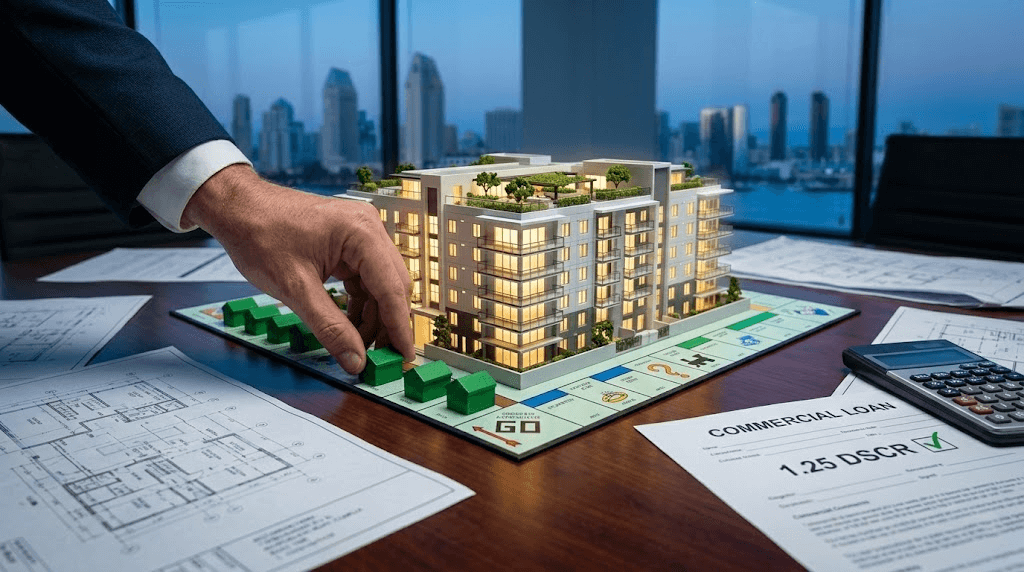
You have mastered the game of Monopoly: you bought four green houses. Now, it is time to trade them in for a red hotel.
For the Growth-Minded Investor, Single Family Homes (SFH) are the gateway drug. They are easy to understand, easy to finance, and easy to rent. But eventually, every ambitious investor hits a ceiling. You max out your 10 conventional mortgages. You tire of managing scattered roofs across three different zip codes. You realize that competing with emotional homebuyers for a 3-bedroom tract home is eroding your margins.
In 2026, the real wealth isn’t in collecting more front doors; it is in consolidating them under one commercial roof. Transitioning to Multi-Family Commercial (5+ units) isn’t just a change in asset class, it is a change in the fundamental rules of valuation, financing, and taxation.
Here is your blueprint for graduating from “Landlord” to “Commercial Operator.”
1. The Valuation Shift: From “Comps” to “Cap Rate”
The single biggest advantage of commercial multi-family is Control.
When you own a Single Family Home, your property’s value is dictated by your neighbors. If the house down the street sells for $800,000, your house is worth roughly $800,000. It doesn’t matter if you have a golden tenant paying double the market rent; the appraiser uses “Sales Comparables” (Comps) driven by emotional owner-occupants.
In Commercial Multi-Family, value is driven by Math (Net Operating Income). Commercial properties are valued based on the income they generate, divided by the market Cap Rate.
- The Power Move: If you raise rents by $500 across a 10-unit building and decrease expenses by installing LED lighting, you increase the Net Operating Income (NOI).
- The Result: Every $1 of additional annual NOI you generate adds roughly $15-$20 to the property value (assuming a 5-6% Cap Rate). You can force appreciation through operations, regardless of what the neighbors sell for.
This is the core principle of how to maximize rental property ROI in Southern California: operational efficiency directly creates equity.
2. Financing: Breaking the “Debt-to-Income” Chains
Many investors fear commercial real estate because they think, “I can’t afford a $3 million loan on my salary.” Good news: The bank doesn’t care about your salary.
Once you cross the threshold of 5 units, you leave the world of “Residential Financing” (Fannie/Freddie) and enter “Commercial Financing.”
- Residential Loans: Based on your personal Debt-to-Income (DTI) ratio.
- Commercial Loans: Based on the property’s Debt Service Coverage Ratio (DSCR).
As long as the asset generates enough rent to cover the mortgage with a safety buffer (usually a 1.25x ratio), the lender will fund the deal. This allows you to scale infinitely. You are limited only by your ability to find good deals, not by your W-2 income.
3. The 2026 Tax Supercharger: Cost Segregation
If you are moving into multi-family in 2026, you are timing the market perfectly regarding tax incentives.
With the recent legislative adjustments permanently restoring 100% Bonus Depreciation, commercial multi-family offers a tax shield that SFH cannot match.
- The Strategy: You perform a “Cost Segregation Study” on your new 10-unit apartment complex. This engineering report reclassifies parts of the building (flooring, lighting, cabinets, landscaping) from a 27.5-year depreciation schedule to a 5, 7, or 15-year schedule.
- The Benefit: You can often write off 20-30% of the building’s purchase price in Year One. On a $2M acquisition, that could be a $500,000 paper loss that offsets your other active income.
4. Economies of Scale: The “One Roof” Efficiency
Managing 10 Single Family Homes means maintaining 10 roofs, 10 water heaters, 10 driveways, and paying 10 separate insurance policies. It is a logistical nightmare.
A 10-unit commercial building has one roof and one insurance policy.
- Maintenance: When you send a plumber to the site, they can service 3 units in one trip. Your cost per unit drops drastically.
- Vacancy: If one tenant leaves a Single Family Home, you are 100% vacant. If one tenant leaves a 10-unit building, you are still 90% occupied and your mortgage is covered.
The “Management Gap” Warning
Commercial real estate is a high-stakes game. The tenants are savvy, the fair housing laws are stricter, and the maintenance systems are more complex (boilers, commercial fire systems, master keys). You cannot manage a 12-unit complex with a spreadsheet and a handyman.
At Three Palms Property Management, we specialize in the specific needs of commercial multi-family assets.
- We manage utility RUBS (Ratio Utility Billing Systems) to pass water costs back to tenants.
- We execute rent increases strategically to maximize NOI without spiking turnover.
- We handle the commercial compliance that DIY landlords miss.
Are you ready to trade your green houses for a red hotel? Request a free rental analysis today, and let us help you underwrite your first commercial acquisition.
