

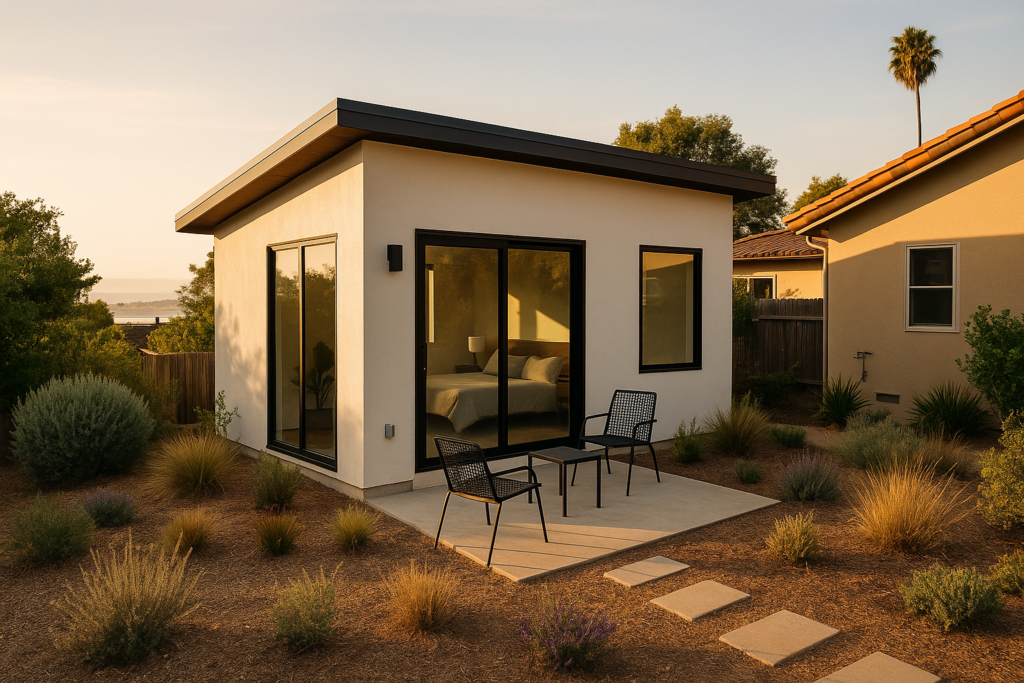
A detached accessory dwelling unit in the right Point Loma backyard can generate on the order of $2,500 a month in rental income while adding lasting value to the property, and California has spent the last several years rewriting its laws specifically to make building one easier. For a Point Loma owner sitting on an underused backyard, an ADU is one of the highest-return moves available in San Diego real estate. But “goldmine” and “money pit” are separated by a few critical decisions. This report breaks down why Point Loma ADUs pencil so well, what makes the neighborhood unique, and how to underwrite the project like an investor instead of a dreamer.
What is an ADU and why is California pushing them?
An accessory dwelling unit is a secondary, self-contained home on the same lot as a primary residence, a detached backyard cottage, a garage conversion, or an attached unit with its own kitchen, bath, and entrance. Facing a severe housing shortage, California has passed a series of laws over recent years that dramatically streamline ADU approval: shrinking setbacks, capping fees, limiting cities’ ability to say no, and speeding up permitting timelines.
For a property owner, the takeaway is simple: the state has deliberately tilted the field in favor of building an ADU. What was once a discretionary, uncertain approval process has become far more of a by-right one, which is exactly why ADUs have moved from a niche project to a mainstream San Diego investment play.
Why does a Point Loma backyard make such a strong ADU?
Point Loma combines three things that make an ADU unusually valuable: high rents, strong tenant demand, and constrained supply. It is a coastal San Diego neighborhood with water views, walkability to the village and the waterfront, and proximity to Naval Base Point Loma and Liberty Station, a steady engine of military, professional, and healthcare tenants who want quality housing near the coast.
That demand meets a supply wall. Point Loma is established and largely built out, so new rental inventory is scarce. An ADU is one of the only ways to add a genuinely new rental unit to this market, and new coastal-adjacent rental supply commands a premium. A well-built one-bedroom or studio ADU in Point Loma can realistically target rents in the neighborhood of $2,500 a month, and the tenant pool to fill it is deep and reliable.
Is a Point Loma ADU really a $2,500/month opportunity?
The $2,500 figure is an illustrative target, not a guarantee, actual rent depends on the ADU’s size, finish, privacy, parking, and exact location. But the underlying logic is sound: coastal San Diego rents are high, Point Loma is desirable, and a private, purpose-built unit rents at the top of the ADU range rather than the bottom.
Run the mental model. At roughly $2,500 a month, a Point Loma ADU generates about $30,000 a year in gross rent. Against that, you weigh the build cost, financing, and operating expenses, and, critically, the fact that the ADU also raises the value of the entire property, because you have converted an unproductive backyard into an income-producing asset. That dual return, monthly cash flow *plus* a step up in property value, is what makes the ADU math so attractive relative to almost any other improvement you could make.
What does Point Loma’s coastal location add to the equation?
Point Loma’s coastal setting is a double-edged sword the smart investor plans for. On the upside, coastal proximity is precisely what drives the premium rent and the deep tenant demand. On the downside, coastal areas in California can carry additional permitting considerations: parts of the coastal zone involve Coastal Commission oversight, and specific parcels may face extra review that inland lots do not.
This is not a reason to abandon the project; it is a reason to do your homework before you design it. Confirming your parcel’s exact regulatory status, coastal zone or not, and what that means for your permit path, is a due-diligence step, not an afterthought. Owners who verify this up front build smoothly; owners who assume can hit expensive surprises.
How should you underwrite an ADU like an investor?
Enthusiasm builds the wrong ADU; underwriting builds the profitable one. Evaluate the project the way you would any income property.
Model the all-in cost honestly
Budget for the full picture: design and permits, site work and utility connections, construction, and a contingency for the surprises every build produces. On a coastal lot, add time and cost for any additional review. The cheapest quote is rarely the true cost.
Underwrite the rent conservatively
Anchor your rent assumption to comparable ADUs and small units that have actually leased nearby, not to the top of the market. If the project works at a conservative rent, the upside is a bonus; if it only works at an aspirational rent, it does not work.
Account for financing and payback
Whether you fund the ADU with cash, a renovation loan, or a refinance, model the financing cost against the rent. The right frame is the payback period and the return on the money invested, plus the value the ADU adds to the property, not just the headline monthly rent.
Plan for it as a real rental
An ADU is a tenancy, subject to the same San Diego and California rules as any other rental: screening, lease compliance, deposit limits, just-cause protections, and habitability standards. Building it is the project; operating it well is the return.
What are the real risks of an ADU project?
The honest risks are manageable but real: cost overruns on construction, permitting delays (especially in the coastal zone), overestimating rent, and underestimating the operating demands of adding a second tenancy to your property. There is also a design risk unique to backyard units, privacy. An ADU that shares too much with the main house, or compromises the primary home’s yard, can hurt the value of both. Thoughtful design protects the rent *and* the property.
None of these break the thesis. They are the reasons an ADU rewards planning and punishes improvisation.
Why does professional management maximize an ADU’s return?
Once your Point Loma ADU is built, its return depends entirely on how it is operated, and a backyard unit sharing a lot with your primary home (or another tenant) has its own dynamics: boundaries, shared access, utilities, and neighbor-tenant harmony. A professional manager markets the unit to the right coastal tenant, screens rigorously, sets the rent to the real market, keeps the tenancy compliant with San Diego’s rules, and handles the day-to-day so the ADU stays a source of income rather than friction.
For an owner-occupant especially, that buffer matters: a manager keeps the landlord-tenant relationship professional and at arm’s length, which protects both your rent and your peace at home. Turning a build into a durable $2,500-a-month asset is an operational achievement, not just a construction one.
Frequently asked questions about Point Loma ADUs
How much rent can a Point Loma ADU generate?
It varies by size, finish, and location, but a private, well-built one-bedroom or studio ADU in Point Loma can realistically target rent around $2,500 a month given the neighborhood’s coastal demand and constrained supply. Confirm the figure against comparable units before you build.
Does building an ADU increase my property value?
Generally yes. An ADU converts unproductive yard space into an income-producing unit, which typically adds value to the overall property in addition to generating monthly rent, a big part of why ADUs pencil so well.
Do I need special permits for an ADU in Point Loma’s coastal zone?
Possibly. Parts of the coastal zone involve additional permitting considerations, potentially including Coastal Commission review. Confirm your specific parcel’s regulatory status early, because it affects your timeline and budget.
Is an ADU subject to San Diego tenant protections?
Yes. An ADU rental is a tenancy like any other, subject to screening, lease, deposit, just-cause, and habitability rules. Build it and operate it as a compliant rental.
What’s the biggest mistake owners make with ADUs?
Underwriting on optimism, overestimating rent and underestimating cost, permitting time, and operating demands. Model the project conservatively, verify the coastal permit path, and design for privacy to protect both the rent and the main property’s value.
Turn the backyard into an asset, not a guess
A Point Loma ADU sits at the intersection of everything that makes San Diego real estate work: high coastal rents, deep tenant demand, constrained supply, and a state government actively clearing the path to build. Around $2,500 a month in rent plus a lasting bump in property value is a genuine goldmine, for the owner who underwrites the cost honestly, verifies the coastal permit path, designs for privacy, and operates the unit as a real rental.
If you own a Point Loma property with an underused backyard and want to know what an ADU would actually rent for and return, request a free rental analysis from Three Palms Property Management. We will model the rent, the tenant demand, and the operating picture so you can decide with numbers instead of hope.
