
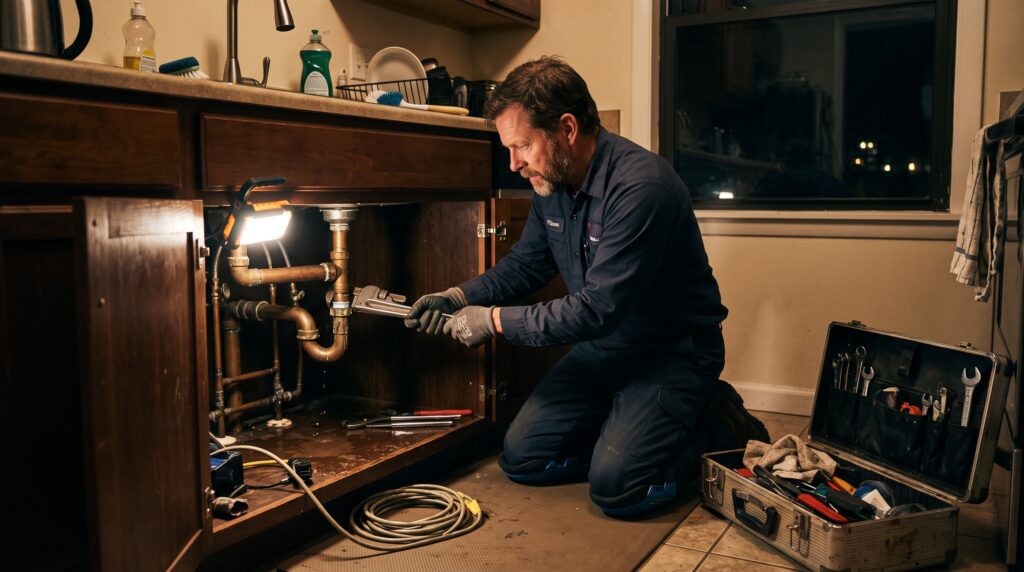
It’s 2 AM and your tenant is calling: a pipe burst, the heat died, the unit flooded, or the power is out. What you do in the next hour is not just customer service — in San Diego it’s a legal obligation. California’s habitability laws require landlords to keep rentals livable and to respond to genuine emergencies promptly, and getting it wrong exposes you to rent withholding, repair-and-deduct, liability, and lawsuits. This guide breaks down what actually counts as an emergency, what the law requires you to handle, and how to be ready before the phone rings.
What legally counts as a maintenance emergency?
Not every after-hours call is an emergency, and knowing the difference is the first step. A true emergency is a condition that threatens health, safety, or causes (or threatens) major property damage — the kind that can’t wait until business hours. Common San Diego examples:
- Major water leaks or flooding — a burst pipe, an overflowing water heater, or active flooding.
- No heat, especially in colder months, or dangerous HVAC failure.
- Total loss of electricity or water to the unit (not caused by a utility-wide outage).
- Gas leaks or the smell of gas — an immediate safety hazard.
- Sewage backups inside the unit.
- Fire, or fire/carbon-monoxide safety failures.
- A serious security breach — a broken exterior door lock or window that leaves the unit unsecured.
A non-emergency — a dripping faucet, a broken appliance that isn’t the stove/fridge, a running toilet, minor cosmetic issues — can reasonably wait for normal business hours. The distinction matters because emergencies demand immediate action, while non-emergencies follow your standard maintenance process.
What does California’s habitability law require?
Every California rental carries an implied warranty of habitability: the landlord must keep the unit fit to live in for the entire tenancy. That includes working plumbing and hot/cold water, adequate heat, safe electrical and gas, weatherproofing, and — as of 2026 under AB 628 — a working stove and refrigerator. When one of these essentials fails, the landlord is obligated to repair it, and for genuine emergencies, to act promptly rather than on a leisurely timeline.
The law doesn’t publish a universal “you have X hours” clock for every situation, but the standard is reasonableness relative to the severity: a burst pipe or a gas leak requires immediate response; a habitability essential like heat or water requires prompt action, not days of delay. The safest posture is to treat any loss of a core essential as urgent and document your rapid response.
What happens if you don’t respond?
Ignoring or slow-walking a genuine emergency triggers real tenant remedies under California law:
- Repair and deduct — the tenant can, within legal limits, arrange the repair themselves and deduct the cost from rent.
- Rent withholding — for serious habitability failures, a tenant may be entitled to withhold rent until the condition is fixed.
- Breaking the lease — a unit rendered uninhabitable can give the tenant grounds to move out.
- Liability and lawsuits — if a failure causes injury or property loss, or if you retaliate against a complaining tenant, you face legal exposure and damages.
- Compounding damage — beyond the legal risk, a delayed response to a leak or flood turns a small repair into a major restoration, mold remediation, and a far bigger bill.
The through-line: a slow emergency response is both a legal risk and a financial one. Acting fast is cheaper than the alternative on every axis.
How fast do you have to act?
For a true emergency, the practical answer is immediately — you acknowledge the tenant, assess the situation, and get a qualified response moving without delay, day or night. For loss of a habitability essential (heat, water, a working stove/fridge), act promptly and keep the tenant informed of the timeline. For non-emergencies, your normal process and a reasonable turnaround apply, but note that even routine repair requests can’t be ignored — an unaddressed “minor” issue can escalate into a habitability problem.
Two constants apply regardless of speed: communicate (acknowledge the tenant and set expectations) and respect entry rules — for a genuine emergency you may enter to address the hazard, but for planned repairs California generally requires written notice (typically 24 hours) and entry at reasonable times.
How do you prepare for the 2 AM call before it happens?
Emergency readiness is a system, not a scramble. The owners who handle 2 AM calls well have set it up in advance:
- 1. A 24/7 reachable channel — a real way for tenants to report emergencies at any hour, and a clear process for what happens when they do.
- 2. A vetted, on-call vendor network — plumbers, electricians, HVAC techs, and restoration pros who are licensed, insured, and available after hours, with pricing arranged ahead of time.
- 3. A clear emergency-vs-routine policy in the lease — so tenants know what constitutes an emergency and how to report it.
- 4. Authority to act fast — pre-approved spending thresholds so a qualified vendor can be dispatched immediately without waiting on a decision.
- 5. Documentation habits — logging the report, the response, and the repair, which protects you legally and on insurance.
Set this up once, and the 2 AM call becomes a defined procedure instead of a crisis.
Who pays for an emergency repair?
A frequent 2 AM question is who foots the bill — and the answer usually favors clarity over conflict. As a rule, the landlord pays for repairs to the building and its systems: plumbing, electrical, heating, the structure, and habitability essentials. The tenant may be responsible when the emergency was caused by their own negligence or misuse — for example, a drain catastrophically clogged by improper use, or damage from something the tenant broke.
The practical guidance: fix the emergency *first*, then sort out responsibility. You never want to delay a habitability repair while arguing about the bill — that delay is exactly what creates legal exposure. Handle the hazard immediately, document the cause, and address cost allocation afterward per the lease and the facts. Trying to litigate fault at 2 AM while a unit floods is how a manageable repair becomes an unmanageable claim.
Why is this harder for self-managing owners?
The 2 AM emergency is precisely where individual landlords struggle. You’re asleep, out of town, or simply unreachable; you don’t have a plumber on speed dial at midnight; you’re not sure whether this counts as an emergency or what the law requires. In that gap, the response slows — and the legal and financial exposure grows with every hour. A single mishandled flood or heat failure can cost more than a year of the “savings” from self-managing.
The problem isn’t willingness; it’s infrastructure. Handling emergencies to the legal standard requires 24/7 availability and a ready vendor network that most owners simply don’t have on their own.
Why does professional management solve the emergency problem?
Emergency response is one of the clearest cases for professional management, because it turns a personal 2 AM burden into an operational system. A property manager provides the 24/7 emergency line, the pre-vetted on-call vendors who can be dispatched immediately, the judgment to distinguish emergency from routine and act within the law, and the documentation that protects you afterward. The tenant gets a fast, competent response; you stay compliant with habitability law; and the small problem gets fixed before it becomes a flooded, mold-ridden, lawsuit-shaped big one.
For an owner, that means never being the person deciding what to do about a burst pipe at 2 AM — and never absorbing the legal and financial cost of getting that decision wrong. The emergency is handled, by law, on your behalf, while you sleep.
Frequently asked questions about emergency maintenance
What counts as a maintenance emergency in a rental?
A condition that threatens health, safety, or causes major property damage and can’t wait — burst pipes or flooding, no heat, total loss of water or power to the unit, gas leaks, sewage backups, fire/safety failures, or a unit left unsecured. Minor issues like a dripping faucet are non-emergencies.
How quickly must a California landlord respond to an emergency?
Immediately for a true emergency, and promptly for loss of a habitability essential like heat or water. The law’s standard is reasonableness relative to severity, so genuine emergencies require action without delay, day or night.
What can a tenant do if I ignore an emergency repair?
Depending on severity, a tenant may repair and deduct, withhold rent, or break the lease for an uninhabitable unit — and you can face liability if the failure causes harm. Slow responses also let small problems become expensive ones.
Do I need to give notice to enter for an emergency repair?
For a genuine emergency you may enter to address the hazard without the usual advance notice. For planned, non-emergency repairs, California generally requires written notice (typically 24 hours) and entry at reasonable times.
Am I required to provide a 24/7 way for tenants to report emergencies?
Habitability law requires prompt response to emergencies, which in practice means tenants need a way to reach you at any hour. A 24/7 emergency channel and an on-call vendor network are how landlords meet that obligation reliably.
Be ready before the phone rings
The 2 AM emergency call isn’t a question of if, but when — and in San Diego, how you respond is governed by law, not just goodwill. Know what counts as an emergency, understand that habitability law requires a prompt response, and build the system — a 24/7 channel, on-call vendors, clear policy, and fast authority to act — before you need it. Do that, and the emergency is a procedure. Skip it, and it’s a lawsuit and a flooded unit.
If you’d rather never take the 2 AM call yourself — and know every emergency is handled to the legal standard — request a free rental analysis from Three Palms Rental Management. We provide 24/7 emergency response and a vetted on-call vendor network, so your property stays habitable and compliant around the clock.
