

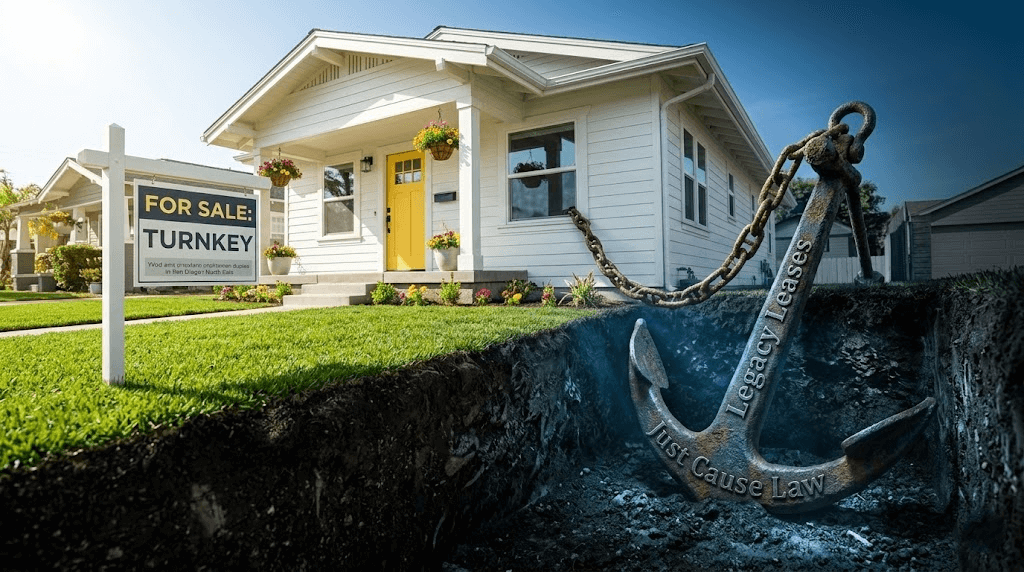
The listing screams “Turnkey Investment!”
It seems like the perfect setup for the Growth-Minded Investor: A duplex in North Park, fully occupied, generating immediate cash flow from Day 1. No marketing costs, no vacancy, no leasing fees. You just close escrow and collect the checks.
In 2026, this is rarely the reality.
Buying a property with tenants in place has shifted from a convenience to a primary risk vector. In San Diego’s hyper-regulated environment, you aren’t just buying a building; you are inheriting a legal relationship that is incredibly difficult to terminate. If that relationship is toxic, or simply unprofitable, you are buying a liability that could freeze your capital for years.
Here is the analytical breakdown of why “inheriting tenants” is often a trap, and how to underwrite the risk before you sign.
1. The “Legacy Lease” Yield Trap
The Growth-Minded Investor buys for future value, the ability to renovate, re-brand, and raise rents to market rates. The Problem: If you inherit a tenant paying $1,500 for a unit worth $2,800, you are mathematically locked out of that growth.
- The Cap: Under AB 1482 (and tighter local ordinances), you are capped at raising rent by 5% + CPI (max 10%) annually.
- The Math: To bridge a $1,300 gap at 8% increases a year, it will take you over 8 years to reach today’s market rate. By then, the market will have moved again.
- The Result: You are paying 2026 market price for the asset, but collecting 2018 revenue. Your “Cap Rate” is effectively frozen.
2. The “Day One” Just Cause Wall
Many investors mistakenly believe they can simply “non-renew” the inherited tenant once their lease expires. In the City of San Diego, this is false.
Under the Residential Tenant Protections Ordinance, “Just Cause” protections apply from Day 1 of tenancy. Even if the lease you inherited ends next month, you cannot force the tenant to leave without a specific, legal reason (like non-payment).
- The Risk: You might buy a 4-plex intending to move into one unit and renovate the others. If you don’t execute the “Owner Move-In” notices perfectly (and pay the relocation fees), you are stuck being a landlord to tenants you didn’t screen, who are paying rents you didn’t set.
3. The “Value-Add” Roadblock (SB 567)
The classic BRRRR strategy (Buy, Rehab, Rent, Refinance, Repeat) relies on vacating units to force appreciation through renovation. SB 567 has severely restricted this.
You can no longer evict a tenant for “Substantial Remodel” unless:
- The work requires the tenant to vacate for at least 30 days.
- You have permits in hand before serving notice.
- You provide the tenant with copies of the permits and scope of work.
The Catch-22: You often can’t get permits without detailed interior inspections, but the hostile inherited tenant can deny access or make inspections difficult. You end up owning a “Value-Add” project where you are legally banned from adding value.
4. The “Estoppel” Defense: Don’t Close Without It
If you must buy a tenant-occupied property, you never trust the seller’s P&L statement. You demand an Estoppel Certificate.
This is a legal document signed by the tenant (not the seller) confirming:
- The actual rent amount.
- Who owns the appliances (refrigerators, washer/dryers).
- The “Side Deals”: Does the tenant have a handshake deal to use the garage for storage? Do they have a “deposit” the seller didn’t disclose?
- Protected Status: Are they claiming disability or protected status that triggers higher relocation fees?
If the tenant refuses to sign an Estoppel, walk away. It means there is a dispute the seller is hiding.
5. The “Cash for Keys” Premium
Sometimes, the only way to unlock the value of your new acquisition is to buy the tenant out. In 2026, this is expensive.
- San Diego City Relocation Fee: Mandatory 2-3 months of rent for no-fault evictions.
- The “Buyout” Market Rate: To get a tenant to leave voluntarily and waive their rights, investors are currently paying $15,000 – $25,000 per unit in high-demand zones.
Investment Insight: You must factor this “De-Tenanting Cost” into your initial purchase offer. If the seller won’t credit you for it, the deal likely doesn’t pencil.
The Verdict: Vacant is Valuable
For the Growth-Minded Investor, a vacant building is often worth a 10-15% premium over an occupied one. It gives you a blank canvas to set market rents, choose your own tenants, and execute your renovation plan immediately.
At Three Palms Property Management, we help investors audit these risks before escrow closes.
- We review existing leases for AB 1482 compliance loopholes.
- We interview inherited tenants (during inspections) to gauge cooperation levels.
- We calculate the “True” Cap Rate, factoring in the cost of potential buyouts.
Don’t let a “turnkey” deal turn into a dead end. Request a free rental analysis of your potential acquisition today. We’ll tell you if the tenants are an asset, or an anchor.
