

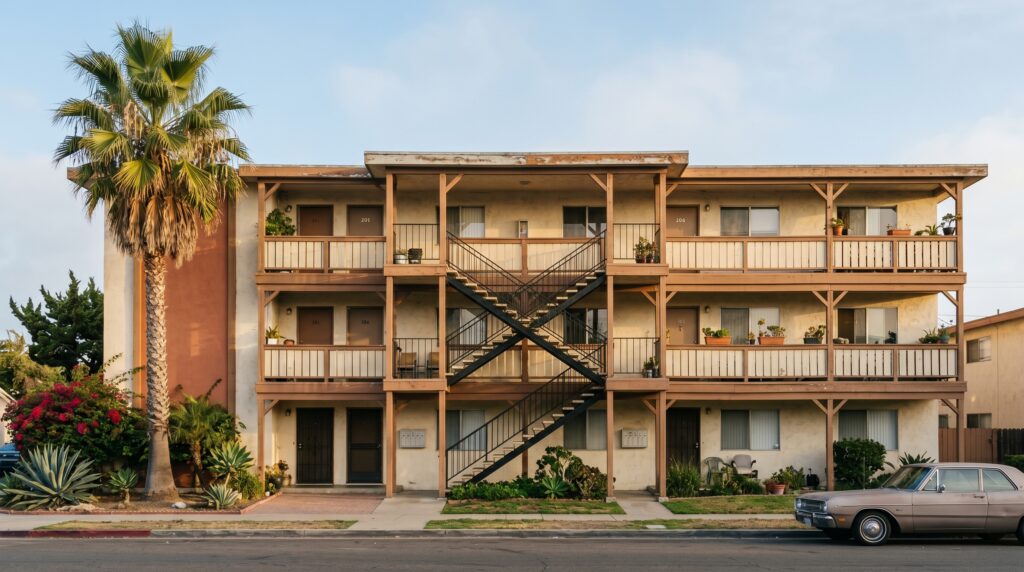
If you own a North Park apartment complex with three or more units, an uninspected balcony can now cost you between $100 and $500 every single day. California’s SB 721 balcony inspection law carries daily civil penalties that compound until the work is done, and at the high end, that math reaches roughly $182,500 in a single year. The original deadline has already passed. This guide explains exactly what SB 721 requires, why North Park’s older building stock is squarely in the crosshairs, and how to get compliant before the fines stack into five figures.
What is SB 721 and who does it apply to?
SB 721 is California’s balcony inspection law. It requires a licensed professional to inspect the “exterior elevated elements” (EEEs), balconies, decks, stairways, landings, walkways, and their railings, on any multifamily residential building with three or more dwelling units. The law was passed after a 2015 Berkeley balcony collapse killed six people, and it targets the weatherproofing and load-bearing components most likely to rot out of sight.
If you own a duplex, you are exempt. If you own a triplex, a fourplex, or a 24-unit complex off University Avenue, you are covered. Condominiums governed by an HOA fall under a sister law, SB 326, instead. For most North Park rental owners, SB 721 is the one that applies.
What is the SB 721 deadline, and has it really passed?
Yes, the first compliance deadline has passed. The original statewide deadline was January 1, 2025. The Legislature then granted a one-year extension to January 1, 2026 through Assembly Bill 2579, signed in September 2024. That extension is now in the rearview mirror. After the initial inspection, SB 721 requires a fresh inspection every six years.
In plain terms: if your building has not been inspected, you are no longer “getting ready” for a deadline. You are already past it, and the exposure to daily penalties is live.
How much can the fines actually cost?
This is where the “$50K” in the headline stops being hyperbole. The enforcement structure works like this:
- Daily civil penalties of $100 to $500 for every day a building remains out of compliance after the enforcement agency issues a notice.
- At the maximum rate, that is up to roughly $182,500 per year.
- The local enforcement agency can place a safety lien on the property for unpaid fines.
- In the most severe cases, unpaid liens can lead toward foreclosure.
Run the numbers on a mid-range fine. At $300 per day, a complex that sits unaddressed for six months accrues about $54,000 in penalties, before you have spent a dollar on the actual repairs. That is the trap: the fine is not a one-time ticket, it is a meter that runs until you act.
Why is North Park especially exposed?
North Park is one of San Diego’s oldest and most beloved rental neighborhoods, and that is precisely the problem for SB 721 compliance. Much of the area’s apartment stock was built mid-century, with wood-framed balconies and exterior stairways that have absorbed decades of marine-layer moisture. Wood, waterproofing membranes, and steel connectors all degrade over time, and the components SB 721 cares about are exactly the ones that fail quietly behind stucco and paint.
Three local realities raise the stakes:
- Age of the building stock. Older wood-framed elevated elements are the highest-risk category and the most likely to require repair once opened up.
- Coastal moisture. San Diego’s marine climate accelerates dry rot and corrosion in the waterproofing layers SB 721 inspectors test.
- Dense multifamily ownership. North Park is full of the 3-to-20-unit buildings that fall squarely inside the law, not exempt duplexes, and not HOA condos under SB 326.
If you have owned a North Park complex for years and never opened up a balcony assembly, you should assume there is deferred condition waiting to be found.
What does an SB 721 inspection actually involve?
The inspection must be performed by a qualified, independent professional. SB 721 limits this to a licensed architect, a licensed civil or structural engineer, a licensed general or specified contractor, or a certified building inspector. The inspector evaluates a statistically significant sample of the EEEs, with a focus on load-bearing components and the associated waterproofing.
After the inspection:
- The inspector must deliver a written report to the building owner within 45 days of completing the inspection.
- The owner must keep copies of the reports on file for two inspection cycles (which, at six years per cycle, means a 12-year paper trail).
- Any element found to need repair or replacement must be corrected by the owner. Emergency conditions that threaten immediate safety trigger faster action and notification to the local enforcement agency.
The report is not a suggestion. It becomes the documented record of what you knew and when, which matters enormously if a component later fails.
What happens if an inspector finds damage?
Findings fall on a spectrum. Minor cosmetic issues may simply be noted. But if the inspector flags a load-bearing or waterproofing component as deficient, the owner is legally responsible for correcting it. Severe findings that pose an immediate threat to occupant safety can require you to restrict access to the balcony or walkway until repairs are complete, and to notify the local enforcement agency.
For a North Park owner, the realistic scenario is this: the inspection surfaces dry rot or membrane failure on one or more balconies, and you move from “compliance project” into “repair project.” Budgeting only for the inspection, and not for the repairs it may trigger, is the most common planning mistake we see.
How does an owner get compliant now?
Because the deadline has passed, the priority is to stop the clock before any enforcement notice converts into daily penalties. A practical sequence:
- Confirm your building is in scope. Three or more units, not an HOA condo. If yes, SB 721 applies.
- Engage a qualified inspector: architect, engineer, or appropriately licensed contractor, and schedule the inspection now rather than waiting for a complaint to trigger enforcement.
- Budget for both the inspection and likely repairs. Treat repairs as probable, not hypothetical, on older North Park stock.
- File and retain the report for the required two cycles, and calendar your next inspection six years out.
- Document everything. A clean compliance file is your best protection against both fines and liability.
This is also where professional property management earns its keep. A manager who already tracks regulatory deadlines, holds relationships with qualified inspectors and licensed repair vendors, and maintains your compliance records turns SB 721 from a panic into a line item.
What does SB 721 compliance cost in San Diego?
There is no single statewide fee schedule, so costs vary by building size, the number of exterior elevated elements, and how the elements are accessed. As a planning framework, think in three buckets:
- The inspection itself. Priced by the number and type of elements and the access required (ladder, lift, or destructive testing). A small fourplex with a handful of balconies is a modest project; a 20-unit building with stacked balconies and multiple stairways is a larger one.
- Repairs the inspection triggers. This is the variable that dominates the budget on older North Park stock. Dry rot, failed waterproofing membranes, and corroded connectors can range from minor patching to full balcony reconstruction. Treat repairs as likely, not optional.
- The cost of doing nothing. Daily penalties of $100-$500, safety liens, and the liability exposure of a documented-but-unaddressed defect. This is the most expensive bucket of all, and the only one that grows every day you wait.
The owners who fare best budget for inspection *and* a repair contingency in the same breath, rather than treating the inspection as the finish line. An inspection that finds problems you have not budgeted for is how a routine compliance task becomes a cash-flow emergency.
Will the inspection disrupt my tenants?
For most buildings, no. SB 721 inspections are visual and component-level, and a qualified inspector works around tenant schedules with advance notice. The disruption risk is higher on the repair side: if an inspector flags an immediate safety hazard, you may need to temporarily restrict access to a balcony or walkway until the fix is complete. Coordinating notices, access, and vendor scheduling, without rattling your tenants or violating notice rules, is exactly the kind of logistics a property manager absorbs on your behalf.
Frequently asked questions about SB 721
Does SB 721 apply to single-family rentals or duplexes?
No. SB 721 applies to buildings with three or more dwelling units. Single-family homes and duplexes are exempt, though owners are still responsible for general habitability and safety.
What is the difference between SB 721 and SB 326?
SB 721 governs apartment-style multifamily rentals with three or more units. SB 326 governs condominium projects managed by a homeowners association. Both cover exterior elevated elements, but they apply to different ownership structures and have different timelines.
How often do I need to re-inspect under SB 721?
After the initial inspection, SB 721 requires re-inspection of the exterior elevated elements every six years.
Can I be fined even if my balconies are fine?
Yes. The penalty is for non-compliance with the inspection requirement itself, not only for defective balconies. An owner who never schedules the required inspection can accrue daily fines regardless of the actual condition of the elements.
Who is allowed to perform the inspection?
A licensed architect, a licensed civil or structural engineer, a building contractor with the appropriate license, or a certified building inspector. Your regular handyman or maintenance tech cannot sign off on an SB 721 inspection.
Don’t let the meter run
SB 721 is no longer a future obligation for North Park owners, it is a current one, with daily penalties that can outrun the cost of the repairs themselves. The buildings most likely to harbor hidden balcony damage are exactly the older, multifamily, marine-exposed complexes that define North Park. The cheapest path is also the simplest: get the inspection scheduled, budget for repairs, and keep an airtight compliance file.
If you own a North Park rental and you are not certain where your building stands on SB 721, request a free rental analysis with Three Palms Property Management and we will help you map your compliance exposure and connect you with the qualified inspectors and vendors to close it out, before a daily fine ever starts ticking.
