

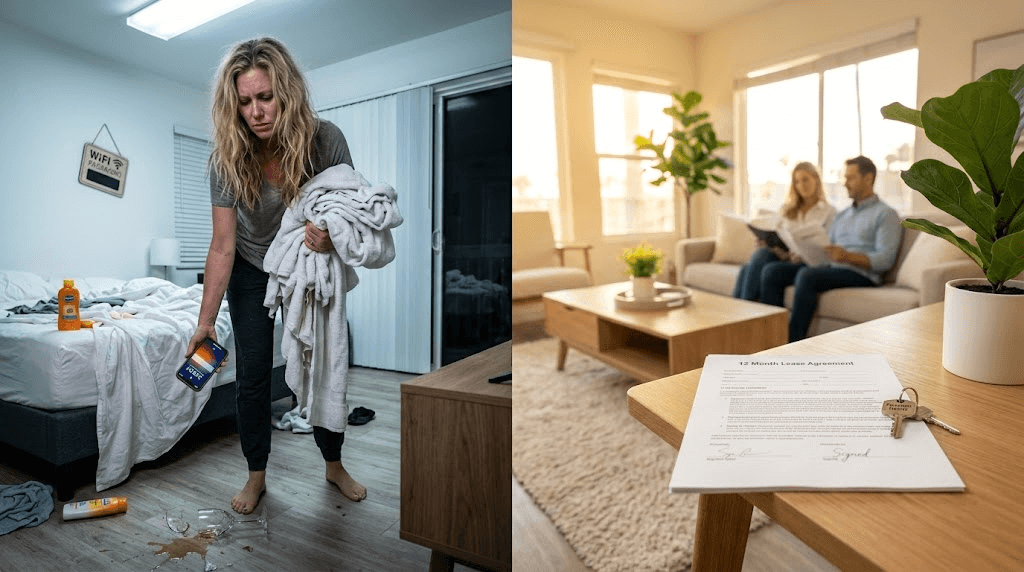
Remember when owning an Airbnb felt like “passive income”? You listed it, a nice couple from Arizona booked a week, and the money appeared in your account.
In 2026, that reality feels like a distant memory. Today, running a short-term rental (STR) in San Diego is a full-contact sport. It requires the hospitality skills of a hotel concierge, the conflict resolution skills of a diplomat, and the legal knowledge of a zoning attorney.
For many owners, the “Airbnb Gold Rush” has turned into a grind of constant turnovers, demanding guests, and regulatory anxiety. If you find yourself dreading the notification chime on your phone, you might be suffering from Airbnb Fatigue.
Here are the four critical signs that it’s time to retire from the hospitality business and convert your asset into a stable, high-performing long-term rental.
1. The “2:00 AM” Dread (Hospitality Burnout)
The most obvious sign of fatigue is emotional. Ask yourself: What is your visceral reaction when your phone buzzes late at night?
If your stomach drops because you assume it’s a guest complaining about the WiFi password, the hot tub temperature, or a beeping smoke detector, you are burned out.
- The Reality: Airbnb guests in 2026 expect 5-star hotel service at a private residence. They demand instant responses, spotless “Instagrammable” interiors, and flawless amenities.
- The Cost: This “always-on” mental load destroys your personal peace. You are never truly off the clock.
- The LTR Fix: A long-term tenant pays their own utilities, buys their own toilet paper, and generally only calls you for genuine emergencies. The shift from “Concierge” to “Landlord” restores your work-life balance immediately.
2. The “Net Income” Illusion
Many owners cling to STRs because the Gross Revenue looks higher than a yearly lease. You might see $8,000 in July and think, “I can’t get that with a 12-month tenant.”
But are you looking at your Net Operating Income (NOI)? When you peel back the layers of a 2026 Airbnb P&L, the margins are compressing rapidly:
- Platform Fees: Airbnb/VRBO take their cut.
- Cleaning Costs: You often subsidize the cleaner because guests balk at $250 fees.
- Utilities: In San Diego, SDG&E rates are among the highest in the nation. STR guests leave the A/C on at 65°F with the windows open. You pay that bill.
- Supplies: Replenishing linens, coffee, soap, and welcome baskets adds up.
The Math: Once you subtract these operational heavyweights from your Gross, the “boring” consistent rent of a long-term lease often yields a comparable, or even superior, ROI when adjusted for effort. Learning how to maximize rental property ROI in Southern California often reveals that “less revenue” with “zero expenses” wins the race.
3. The Regulatory Target on Your Back
In neighborhoods like Pacific Beach, Mission Beach, and North Park, Short-Term Rentals are under a microscope.
- The Neighbor Watch: Residents are increasingly hostile toward STRs. One noise complaint can trigger a Code Enforcement visit or a fine from the “Blue Team” (San Diego’s enforcement division).
- The License Anxiety: Renewing your Tier 3 or Tier 4 license is stressful. Will the rules change? Will the lottery cap shrink?
- The LTR Fix: Long-term rentals are federally protected housing. You don’t need a lottery ticket to operate one. While you must navigate rent control (AB 1482), a comprehensive guide to legal requirements for Southern California landlords can help you set a compliant, stress-free lease that no City Council vote can take away.
4. The “Wear and Tear” Acceleration
There is a myth that long-term tenants damage homes more. The data suggests otherwise.
- STR Reality: A suitcase rolling across your hardwood floors 100 times a year does damage. 50 different groups flushing your toilet, using your appliances, and opening your cabinets creates “accelerated depreciation.”
- The “Party” Risk: No matter how well you screen, one bad weekend group can cause $5,000 in damage that the security deposit barely covers.
- LTR Reality: A long-term tenant moves their furniture in once. They treat the home as their sanctuary. With regular property inspections, you can maintain the asset’s condition without the weekly turnover battering.
The Pivot: Making the Switch Safely
If you are nodding your head, it’s time to pivot. But don’t just delete your Airbnb listing today.
- De-Stage the Home: Remove the “hotel” clutter (extra linens, decorative soaps, fragile decor).
- Audit for Compliance: Ensure your property meets long-term habitability standards (carbon monoxide detectors, heating, secure locks) which differ slightly from vacation rules.
- Market for Stability: Position your home to attract the “High-Earner” tenant who wants a 12+ month stay.
At Three Palms Property Management, we help exhausted hosts transition into passive investors. We handle the marketing, the screening, and the legal lease drafting so you can finally delete the Airbnb app from your phone.
Ready to get your weekends back? Request a custom quote today, and let us show you the peace of mind of a 12-month lease.
